If You Want Results, Think About HOW You Post And Share Content

how you post and share content matters

If you listen to me long enough and you’ll know I am more focused on social networking and being engaged than creating content. I’ll keep saying it too….


Your content is designed to play a supporting role.


People do business with people. They build relationships. They act on those relationships. When they choose to act is when your content matters. It is at that point they will read (or read again). It is at that point they will decide if, aside from having that relationship with you, they trust you are the right person or business to hire.

Content isn’t the most important thing…. what you post and more importantly, HOW you write, post or share content IS critical.

Your content MUST have a purpose

Your content MUST serve a purpose. It must help build relationships, must be authoritative and/or must drive action.Click To Tweet

Not every post needs to do all of it, and the best content will hit multiple points. If your content doesn’t hit on at least one of those points, you’re wasting your time posting it. PERIOD

I adore Rhonda over at Fat Dog Creatives. She’s a fantastic graphic designer and her process is incredible. She’s also a big proponent of me (yes, I have an ego).

She shared one of my Facebook posts about the value of engagement  to her business page. I immediately thanked her (as Tactical Social Media, though I could have as myself.) and as quickly as I did, I scolded her. Love that she shared it, hate that while it was good for me, it did nothing for her!

She already decided to share my content. She gave me something, so why not leverage it to truly nurture the relationship, to establish her own authority, drive some action and share a little bit of herself? She should use it further help herself.


Blindly posting or sharing content provides little value to YOU. Make what you post count for you AND your audience.Click To Tweet

How you create your post matters

How the share first appeared…..

How you post and share content matters

Here’s the edited version…..

How you post and share content matters if you want to see results

The difference?

She leveraged my content to help build her authority. She continues to nurture our relationship (more than simply sharing my content, she acknowledges she is learning from me – that ego thing again) and she is making it personal and herself more relatable to her clients.


The bonus… Rhonda will get some HUGE additional visibility:

*  She tagged me (with permission – do not ever tag a person in a business post without permission. It is rude and a relationship killer) placing her post on my timeline. Her brand was promoted to my personal network.And since I was tagged personally, I responded personally. That adds further reach.

*  She has real content that could be found later when someone uses Facebook’s search function (and trust me, they do!).


While I will continue to preach that content is less important than social engagement, there is no doubt content is vital. It’s not about how much content you post, how often or when.


It is about WHAT you post and HOW you post and share content that matters.

What If Improving Your SEO & Search Ranking Was Simple?

A simpler approach to SEO

I loathe how SEO is made out to be a complicated, non-understandable concept.  The way I see it, through its highly complicated algorithm, Google actually tries to recommend sources the same way you or I would.

Google’s goal, like yours or mine when we’re asked for a referral or recommendation, is to provide the best results based on what it is asked.

So….

I looked at how I chose to refer others and started applying the same thought process to how I approach SEO.

If you ask me to refer, a web developer, I’ll give you a few names.  Who I recommend and the order I recommend you contact them (ranking) is based ultimately on only 3 factors:


  • Who can provide what you need (search query)
  • How credible they are (authority),
  • Where you or they are located (location).


While I do look at other considerations when making referrals – things like personality conflicts – those are reserved for help refining the ‘search results’, not for actually determining who to ‘return’.


Applying this Concept to Google

What if I narrowed down the 200 factors Google actually uses and only concern myself with three of them – the three, as it turns out, are pretty simple?

If you want me to consider recommending or referring you, at the minimum, I need to know what you can provide in the way of products and services, show me you are credible and where you work. Much of what I, or you, will learn about someone is through networking groups and events. When first meeting, credibility is hard to gauge and it is near impossible to learn everything you provide. Heck, there are people I have known for years and I am finding out some of the things they do! Over time, and with continued interaction, I learn more. I meet others and hear testimonials. I get a good sense of the work you provide and your reputation. The more we network, the more I learn and more comfortable I am with recommending you.

As I see it, Google does this using your content as opposed to conversation. You write, Google learns. The more you write, the more Google knows. As you write more, the content, whether web pages or blog posts, builds a knowledge base. Authority comes from your content (based on sitewide keyword density showing Google you are the subject matter authority) and backlinks (for all practical purposes, testimonials).


Understanding search query 

In a real broad stroke, while people still search for keywords, the move is clearly toward looking for answers. Searches are more natural now. Rather than searching for “social media for SEO’, people are more likely to search for ‘How does social media effect SEO’ or ‘How do I use social media to improve my SEO’. It’s how I search.

And if I had no idea what question to ask? I will start with a broad keyword. Interestingly, the keyword itself rarely provides a link I’ll click. What it does is help me refine what I need to enter in the search box.

Knowing this, I pay little attention to keywords. I’m concerned with knowing what my audience wants or needs to know. I’ll let others worry about keywords that help narrow the search in my favor.


How to improve

Tailor how and what you write with this in mind. Strive to write quality content which provides the answers your audience needs is asking, on the topics where you have expertise. Your goal is to do it and in a way which is easy to read and understandable. [perfectpullquote align=”right” cite=”” link=”” color=”#123517″ class=”” size=””]How often do you search in Google then use what is provided to perform a more targeted search?[/perfectpullquote]

Focus on the narrower search – specific content for specific searches. It means less focus on keywords which you would not likely rank for given the size and authority of your site.

Write for your audience. Write to provide answers or make others think. Do not write for SEO.

Bonus: If you continue to write for your audience on subjects where you have expertise, over time industry keywords will appear naturally. More so, rather than specific articles ranking for a word or phrase, your site will rank for them. This sitewide keyword density goes a much longer way to building site authority.


Authority 

When you look to hire anyone, you want the expert. While I do not know exactly what Google uses to determine authority, I have some ideas based on what I have learned over the years and a little common sense applied from the factors above I use personally.

For SEO, a good measure of expertise is a site’s Domain Authority. Moz looks at a variety of factors from a site’s link profile to trust scores to calculate, based on Google’s algorithm, how likely a site will be to rank in searches. In general, the higher a website’s domain authority (trust, expertise) the more likely site content will rank (or ranking higher) for a given search query than a similar site.

Domain authority, like Google’s algorithm, is based on a variety of factors and not easy to influence. So rather than try, I have found it best to work on two specific aspects:


  • Reducing the appearance of spam – things like too many outbound links relative to the size of your website, paid ads, etc.
  • Increasing the number of quality backlinks from other authoritative (and preferably more authoritative than your own) sites.


Spam

How external linking, or linking out, affects SERPs has been the subject of numerous articles. From a common sense position, it has no direct effect. The value comes indirectly from increasing credibility by citing sources. Credible articles are more likely linked to (backlinks) and shared (increased visibility leading to greater potential for backlinks).

Too many external links, however, has the exact opposite effect. How credible or authoritative can it be if all you do is link to other sources? Highly authoritative articles cite references to back up their ideas, not rely on them to make their case. (And traditionally too many external links likely meant the point of the article wasn’t to inform. It was to drive traffic to other sites – most of which were spam.)


How to improve:

Reducing spam does, to a degree, require time. My spam score as measured by Moz was at 3 until recently (it’s now 1). Newer websites generally contain less content making the number of outbound links relative to your amount of content higher. When you write articles, do not ‘overdo it’ when it comes to external linking. It is the best means of limiting how much effect spam scoring has on your rankings (aside from posting paid ads which should never be done).


Backlinks

This is the single best way, in my opinion, to improve your authority. More quality links from reputable websites tell Google your site is credible. The higher the Domain Authority of the referring site, the more ‘link juice’ you receive. Your goal is to create a link building strategy aimed at receiving quality, natural (no link swaps or paid links) backlinks from the most authoritative sites possible.


How to improve:

Start with writing those quality, easy to read and understand articles on subjects in your field of expertise.

Get those articles visible! Getting your article seen by the right person is the foundation for pure, organic backlinks.

The latter is the biggest hurdle, especially for a new brand or website with little to no initial authority (the old Catch-22). So how do you do it? This is one of the biggest values of social media. Social sharing of blog content is the single best way to create visibility. If you have built the right relationships, share your content and drive traffic through social networking, it will be seen.


Location 

While Domain Authority plays a significant role,  credibility is everything. Aside from it, there are numerous other critical factors tied to site architecture (design and coding). The one other thing that will, however, have a significant impact for local SEO – your reviews. Check out this case study done by Pam Ann Marketing.


How to improve 

The two best steps you can take:

1)  Make sure all of your address listings across the web are correct and most importantly are on your website – including in the coding.

2)  Get those positive, genuine reviews!


My bottom line

There are far more moving parts to SEO than what I have listed above. I do not want you to think this is all you need to know. However, I have been able to significantly improve my SEO and SERPs (being in the top 10 results on multiple search engines for multiple keywords and phrases) and build the domain authority of this site in a very short time strictly by doing what I have written above:


  • Writing for my audience, not SEO (in fact, I never did ANY keyword research for this site).
  • Building my Domain Authority using a link building strategy driven by the relationships built through social networking.


I do adhere to some basic SEO principles by checking what I write and optimizing it with Yoast’s WordPress SEO Plugin, though, in the end….


SEO for me comes down to writing good content which answers the questions your potential customers are asking in a straightforward, readable and authoritative manner.


Do these consistently over time and, for the most part (assuming your site was properly developed), SEO will take care of itself.


A final note

I focus as much on SEO as I do social media for a simple reason – the big picture. One goal of your social media marketing strategy should be focused on driving website traffic. Your website is your best source for lead generation and most likely sales point.

Social media has an incredible ability to drive traffic directly through content and indirectly, by way of improved SEO and search rankings, through social networking. Developing an overall blueprint to accomplish your goals requires both be tightly integrated. Social media and SEO go hand in hand.

Why You Need To Spend More Time On Social Networking

What if you could spend less time writing content and still drive web traffic and generate leads?

Oh. Wait. You can….and I do!

Social Networking: Lead Generation Without Content

I spend the majority of my time actively networking, not posting and sitting on my ass hoping my content is seen. I follow specific people and pages. I interact, support and add value. That simply activity, which is easy and honestly, fun, is what YOU should be doing and what I  have found to be the BEST way to leverage my time on social media.


One of those I follow is my friend (and one of my influencers) Debra Jason. We met on social media through a mutual friend. While we have yet to meet in person, we have spent a good deal of time networking together and supporting each other.

I am always reading her content (it is that good). She recently shared a post from her website, The Write Direction. As a standard practice I commented on the post itself and to further support her, also took the time to add a comment directly on the blog post itself.


The result of networking and interacting with Debra:

  • I saw her social share of the post.
  • I added a valuable comment on social and the blog post itself
  • One of her blog readers saw my comment.


Apparently, the comment made an impression. Not only did they track back to my post (Want Results From Facebook? Stop Sitting On Your Ass!), they filled out my lead capture form to sign up to receive my content in their inbox!


Lead generation through social networking, not content.


A perfect example of driving web traffic and lead generation WITHOUT content.

I’ll add this is not an isolated example of driving web traffic from social networking. There is this one:


Value of commenting on a blog post found through social networking


And this one:


Driving web traffic through social networking


Social networking is how I have been able to leverage social media effectively to build my brands since 2007, and it’s proven to remain highly effective through all of the algorithm changes.

A single value-added comment might just be worth far more than any piece of content you post.


Consider spending less time on your content and more on being active, visible and engaged.Click To Tweet

What If? Rethinking Use Of The Automated Direct Message.

What If The Auto DM Was Used Differently?

I have never been a fan of using the automated direct message feature on Twitter. In fact, I downright hate it. How much? I will unfollow 90% of those who send me an automated direct message within minutes of my reading it.

I often finding myself challenging the norm. I’m always looking at ways to leverage the tools at our disposal in a different way, to achieve a different goal. Twitter’s direct message feature may be one of the best social media tools we have at our fingertips: it provides direct access to followers which could number in the 1000s even for a small brand.

As I see it, the problem with the automated direct message isn’t the use of it, it’s HOW it’s used.


Auto DMs tend to fall into one of two general categories:

  • The simple ‘Thank you for following me” At least take the time to make it look like you are personally thanking me. - Twitter automated direct message fail.– This one may seem fine, but how unsocial is it to send an automated greeting to someone you just met? At least make it look like you took the time to personally thank me.


  • The ‘Please follow me over on Facebook, LinkedIn, sign up for my email, you may be interested in, buy my crap’Example of an automated direct message which resulted in an immediate 'unfollow'. – I get this is an opportunity to drive web traffic, promote your wares or get an email address but at least send me welcome note and ask how I am first. If I walked into your retail store and you asked for my email address or tried to sell me something without saying hello first, I’ll exit stage left…immediately. At least take the time to be social, even for just a moment.


But What If?

  • What if automated DM’s were more like follow-up emails sent to subscribed followers?
  • What if we used them differently?
  • What if we treated our followers the same way we do when they fill out a contact form, sign up for a newsletter or get a free download?
  • What if the content they received wasn’t a request but us giving something? Maybe a piece of advice? Maybe a free download without requesting an email address?
  • What if the DM provided something of value to them rather than a pitch to buy, download, follow, try my crap?

Would you accept them or still see them as spam, insincere, rude or annoying?


The Automated Direct Message As An Effective Marketing Tool

To make them an effective marketing tool three things must change:

Expectation. When we sign up for a download, fill out an entry form at an event or sign up for anything, we KNOW we’re being added to an email list. We expect that. We know we’ll receive an email a few days later saying thank you. We know we’ll likely receive offers and requests (hopefully mixed in with some valuable content).  So what is different between signing up for an email list and following someone on Twitter?

 “….when you sign up for an email list, you expect to be emailed. It’s intrinsic to the nature of that transaction. When you follow someone on Twitter, though, your purpose isn’t to be contacted privately – it’s only to see what they publicly post. Receiving a DM isn’t necessarily part of the equation, so it can seem a little invasive, or annoying. (You already get promotional messages in your email inbox – do you really want them showing up in every one of your other inboxes all across the Internet?)” 

– Tom over at Team Edgar in response to a discussion we had a few weeks back on an older article on Twitter’s change in its DM rules.

I agree completely with the reason we follow someone isn’t to provide private, targeted access but given the pervasive nature of them, I think we EXPECT to be contacted privately.


Perception. Direct messages are so maligned, even if used to provide value, they would be ignored or result in the inevitable ‘unfollow’.

Side note: If you scroll back to the top, you’ll notice I said “I will unfollow 90% of those who send me one within minutes of my reading an auto DM.” What about the other 10%? I have received messages which resonated, provided value or, based on the source, weren’t seen as spam.

Given my own approach and as much as I detest them, I think perception can be changed.


Personalization. Even once the expectation of receiving and perception of DMs changes, there is the small issue of tailoring the message. When it comes to email, we can easily segment to tailor our message. We can personalize each email. You know when you receive them they are automated but at least they address and speak to you. There still needs to be a tool which enables this functionality with a minimum of input on our part to make it effective.

There are a few tools already available and designed to send automated DMs but I don’t think any have the same functionality of most email or CRM tools (please let me know if any do).


A Final Thought

Twitter’s direct message feature holds some interesting potential as an effective marketing tool. It’s a huge opportunity to establish a relationship if / when used properly.  If it will ever be accepted is a whole other story as a viable or trusted. For now, I don’t see myself using it on a broad, automated level. I may start playing with it on a manual basis similar to how I respond to all requests to connect on LinkedIn so don’t be surprised if you follow me and I reach out to you. It is, after all, social behavior and an opportunity to build a relationship and that’s the real value of social media.

What is your opinion on the use of direct or automated direct messages?

Do you see a potential for using them?

The 140 Character Limit: I’m Not Ready to Kiss It Goodbye

Goodbye To Twitter’s 140 Character Limit…


UPDATE (16 May 2016) – “Twitter Inc. will soon stop counting photos and links in their 140-character limit for tweets, according to a person familiar with the matter.”  


I mentioned back in an October 2015 post about a few of the recent changes with the big one the removal the 140 character limit for direct messages. For businesses, this was a HUGE positive move. It was hard to have any real significant dialogue whether it be with a customer or colleague when you were forced to send multiple messages for one thought. I remember a few conversations I migrated to LinkedIn just so we could actually communicate.

The ubiquitous 140 character limit remained for public Tweets. Now there is a buzz again over Jack Dorsey’s hint at increasing it to 10,000, the same new limit for direct messages. (Update: For now, at least, there will be no change in the character limit. It’s still worth considering a few ideas for what COULD be changed to increase character counts while still maintaining limits.) How it will affect Twitter’s role for businesses, especially small, unknown brands is obviously unknown but a few of my thoughts based on having used Twitter since 2009:


The Art of Twitter Effect

For someone who enjoys writing and provides copy editing services, Twitter’s character count means I am continuously perfecting my craft. Can I get my message across, can I get you to click-through to a link and can I get you to further convert using only 140 characters?  And when it comes to resharing old content, I get to play with different content to see what gets noticed or picked up in searches.


Getting content seen and engaged with on Twitter has become an art form.


Based, at least on what has been reported, the skill in getting a Tweet seen will not likely change. What will change is what happens when a Tweet is seen. This’s where the real concern lies. It’s where the copy editing skills will shine and the art form elevated.


Web Traffic Effect

If your content is crafted well and seen in a feed or pulled in a search, the default action (and what you want) is clicking on your website link. That’s web traffic. That’s an opportunity to capture lead information. That’s an opportunity to convert.

What happens when content can be directly added to a tweet? No reason to click-through.


Given the amount of web traffic I see from Twitter and the quality of it, I’m not ready to give that up.


Yes, there still is a huge opportunity by creating compelling content within the tweet to get the click-through, but that requires even more action and time on the part of the reader (personally I’m always tapped for time):


  • Get the reader to see or find the tweet.
  • Get the reader to expand the tweet
  • Get the reader to actually ingest the content.
  • Compel the reader to want to more.


The last point is the tough one.  The additional content has to be crafted perfectly to be read, understood and still drive one more action – for me ,a link click to this site. Depending on how the change is implemented you may even be able to add  in an image, an animated gif or a short video. The bonus with the longer character count – you can have multiple CTAs and links. Regardless, your content will need to be able to encourage further action. Rather than focusing on web traffic depending on post length will they really need or want to read more?), your link CTA may need to be direct list sign ups, registrations, downloads or purchases. Suddenly not only is the art form alive, it’s is elevated to a whole new level.

For me, what still likely gets lost is website traffic. Granted list sign ups, sales and downloads are valuable, but I still have a chance at those when you’re on my site. It’s more about what else I get. You’re exposed to more content than just one article whether it be through links within a post or content in a sidebar. Regardless, the reader is ON my site. Even without additional content being consumed or traditional conversions, there’s still an opportunity to bookmark my site or grab an RSS feed.

On other platforms, I see less traffic to my site and I suspect it’s in part due to NOT needing to click. All of the content is already visible. While you can still create ‘teaser’ posts, I find those to be click-baiting when the opportunity is there to tell me more and you don’t. I know all you are after is that click. (The practice costs you search value – more on that in a minute).

A blog post in a tweet may provide new opportunities but I’m worried about the ones lost. I’m not convinced what we gain makes up for the losses.


The Readability Effect


As of April 2015 80% of Twitter users were mobile.


Increase content within Tweets offers the plus of not having to follow a link but the length of the tweet could affect if it is read. Reading anything long, having to continuously scroll, then still potentially needing to click on a link could make for a very cumbersome read on mobile devices.  I won’t even begin to consider writing a long post from a mobile device. Twitter’s current format favors mobile devices. In fact, aside from Instagram, it’s the ONLY social site I prefer on mobile.

One nice feature now is actually the ability to have a link to click for external reading. If I can easily open a browser window and bookmark a page to read later. Remove the link and if I see something I like, getting back to it could be a challenge.


The ReTweet Effect

There are two sides to how this can play out. The first is compounding the effect of losing web traffic. If web traffic is reduced by fewer URL clicks in tweets, it makes sense for the effect to carry over to ReTweets. In my case, approximately 15% of my web traffic is driven from my ReTweets. Not a significant amount of traffic but still another hit.

The flip side?

I see far too much content reshared that shouldn’t be. No time is taken to actually read the content, presumably because it actually TAKES time.

The end result can often be a hit to one’s reputation. While this will not change when using auto retweeters (really, I beg you not to do this), removing the need to follow another link may mean more content is actually read and less crap is reshared. End result – a less cluttered feed filled with better quality content.


The Search Effect

One big positive being touted by Jack is additional text being searchable. It just may be the best thing about removing the 140 character limit. With 1500 million visitors (as of 12/10/15) who do not log in, more searchable content matters. If you know how to write good copy (again, the Art of Twitter Effect) and Tweet often, this could be a be a huge win. Of course, it also means with everyone posting more your actual odds of content appearing in a search could decrease.

More searchable content, however, still doesn’t diminish the lost web traffic effect. It could also lead to wide scale abuse in due to keyword stuffing and other black hat ‘SEO’ practices.

(The Search Effect Side effect: This could create an internal Twitter SEO industry.)


The Conversation (or the Customer Service) effect

My favorite reason for loving Twitter (even more than the oodles of web traffic I get) is it’s ability to build and grow relationships. Yes, it can be done effectively elsewhere (I’ve been having a great conversation about life, this industry and working together on a few projects with the Fabulous Amy Donahue of Get Hybrid Social on LinkedIn), but Twitter offers me something exclusive – brevity


Twitter’s beauty has alwaysd been in its brevity.


Since I can get wordy – this article is over 2100 words – being forced to cut it short is a good thing for me. Then there’s the time management issue. Tweets were set to 140 character limit for compatibility with SMS messaging. As life has gotten busier, as demands for our time have increased, it’s been harder to sit down and chat for any length of time. I found myself scheduling time for conversations with friends. That meant longer intervals between speaking. Text messaging has enabled me to have ‘conversations’ and ‘talk’ regularly. It allowed life to proceed and still maintain or grow connections. Twitter, for me, works the same way. For business, it’s the equivalent of constant customer contact and top of mind awareness.

I’m concerned the messages could start becoming longer, requiring more time to read, longer replies and ultimately become too time consuming.

Not to be completely negative here, having the ability to expand a tweet still works for me (and I’m excited about the prospect). There are times I truly could use an extra 20 characters.

I really dislike abbreviations and shorthand (and you’ll rarely see me use them). To me they’re less professional and using them runs the risk of miscommunication. The 140 character limit means sometimes having to use them or change the content and what I really wanted my message to be. That’s one thing for my content but another for conversations and especially customer service.

I have a number of Twitter conversations most days and keeping within the 140 character limit is easy. But what happens when it’s a customer service question? What happens when the answer simply cannot be cut short? That means multiple, continued Tweets. It works but still a choppy conversation. It would be nice in these circumstances to have some extra real estate.


The Meta Description

This is not the first time the character count has been discussed. If there is no change, I expect it will be brought up again.  That means thinking ahead. True, I do not need to change my posting strategy.  I can still march on as I have been doing. I may even be successful for a time but….

Failing to adapt in a changing environment, however, rarely has a good outcome.


My posting strategy if and when the 140 character limit is removed:

What if Tweets were structured like Google’s search listings?

The body of the tweet, the 140 character limit you see now, would continue be the attention grabber, what gets you to stop and hit ‘expand’. It’s the article or page title in the SERPs.

The expanded content would contain the post link with a short description, effectively the post’s meta description. Like the meta description in search listings, it’s what truly determines if the link is clicked.  Only in this case that ‘meta description affects the actual search results.

A Tweet for this article would look like:

Are you ready to kiss Twitter's 140 character limit goodbye?

The expanded version:

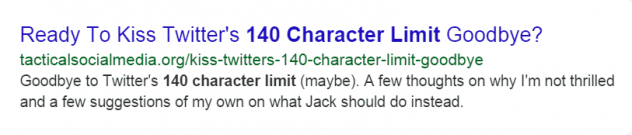
What if Tweets appeared in your feed looking more like a Google search page result?

The art form remains. Instead of writing content to be seen in a feed or picked up in searches and getting the external click through, it’s slightly altered to produce an internal click. The bonus is in getting a few more characters to work to use (your link moves to the body of the Tweet).


What I’d Like To See

I do like the idea of changing up Twitter. I think it could use a refreshing. I do however like much of what has made Twitter such an awesome platform for many of us using it. Going from a 140 character limit t0 10,000, while offering some positives comes at the potential expense of diminished web traffic and a few other negatives.

So what would I do?

Granted no one is asking my opinion, especially Jack Dorsey himself but that’s never stopped me before so…..


Simply thinking about how I would approach posting above, maybe a hybrid of what we have vs what is proposed may work best.

  • Split Character Limits: 140 character limit for the visible portion of  tweet and 155 (from Google’s meta description length) for the post body. This more than doubles the character count, adds the search value from more text, makes conversation (customer service and relationship building) easier, maintains Twitter as a great source of web traffic and still keeps with the initial reason for the character count. Add in a link, image or video at the end (not counting towards the character count).
    .
  • No links in the visible portion of the tweet.  This should encourage more quality content within the visible portion reducing clickbait practices as well. It would force content writers to step up their game. While Twitter would still be a good source of web traffic, you will have to put in a little more effort to get it. Want the traffic? Your content needs to generate two clicks. One to expand the post and one to get to your site.
    .
  • A post save feature: Yes, I can click on a tweet’s timestamp, open it in my browser and bookmark it for later, but it would be so much nicer to have a ‘save’ button. Then I’d have access to the content long term. Even give me a column next to Notifications called ‘Saved Tweets’.
    .
  • An edit feature: None of us are perfect. (Thanks to Angel Rubia for the suggestion during today’s #DigiBlogChat with Carol Stephen.)